

Conservation Manager Chad Machinski, M.S., manages the stewardship of MA’s sanctuaries and engages with our dedicated volunteers. To help you stay connected with the work being done, he will be presenting regular online updates about activities going on at them: birds seen or heard, conservation work, improvements, interesting plants, and more.
Bernard W. Baker Sanctuary
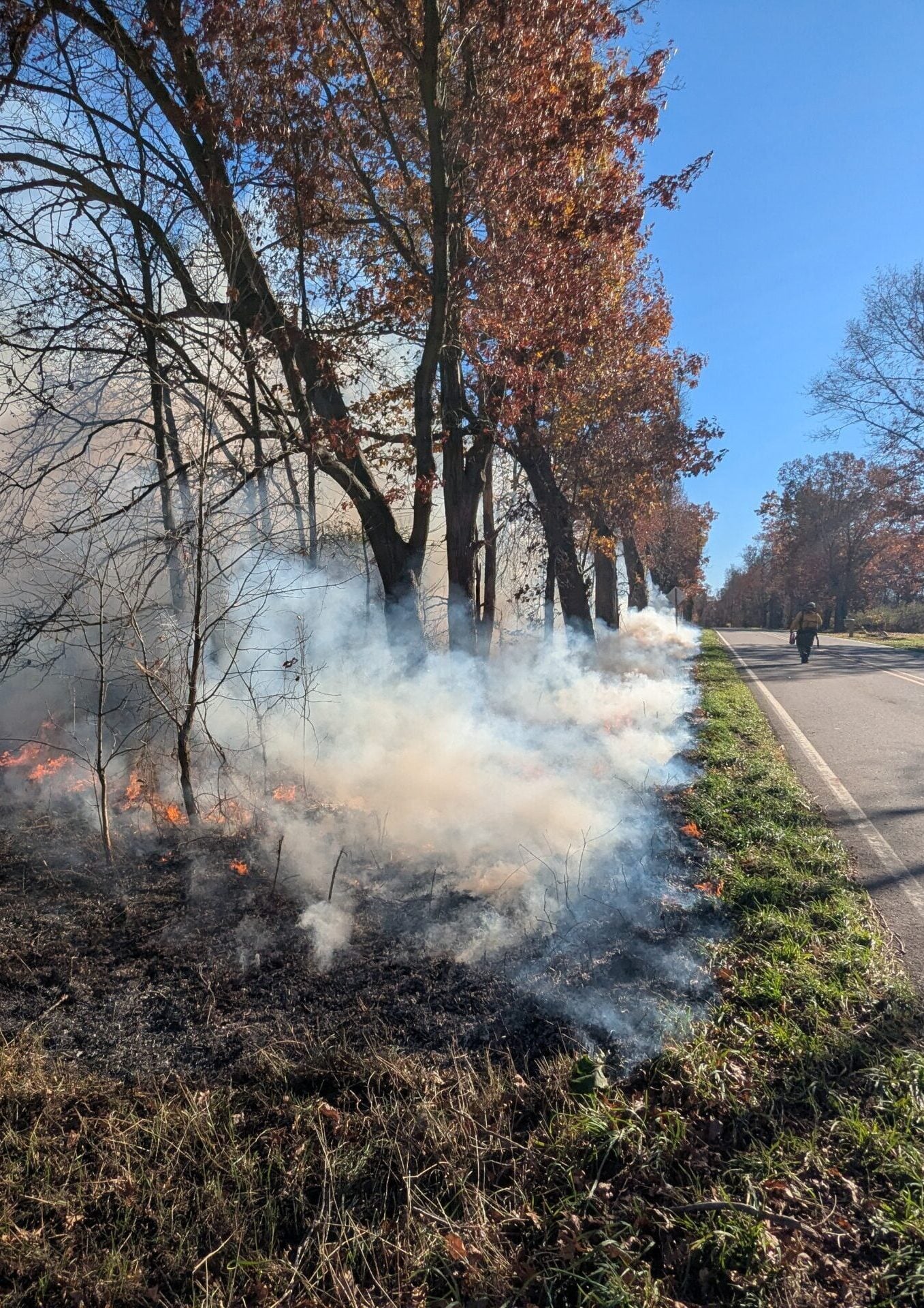
Consistent west winds kept the smoke off the road and allowed burning near the road. Photo by Chad Machinski
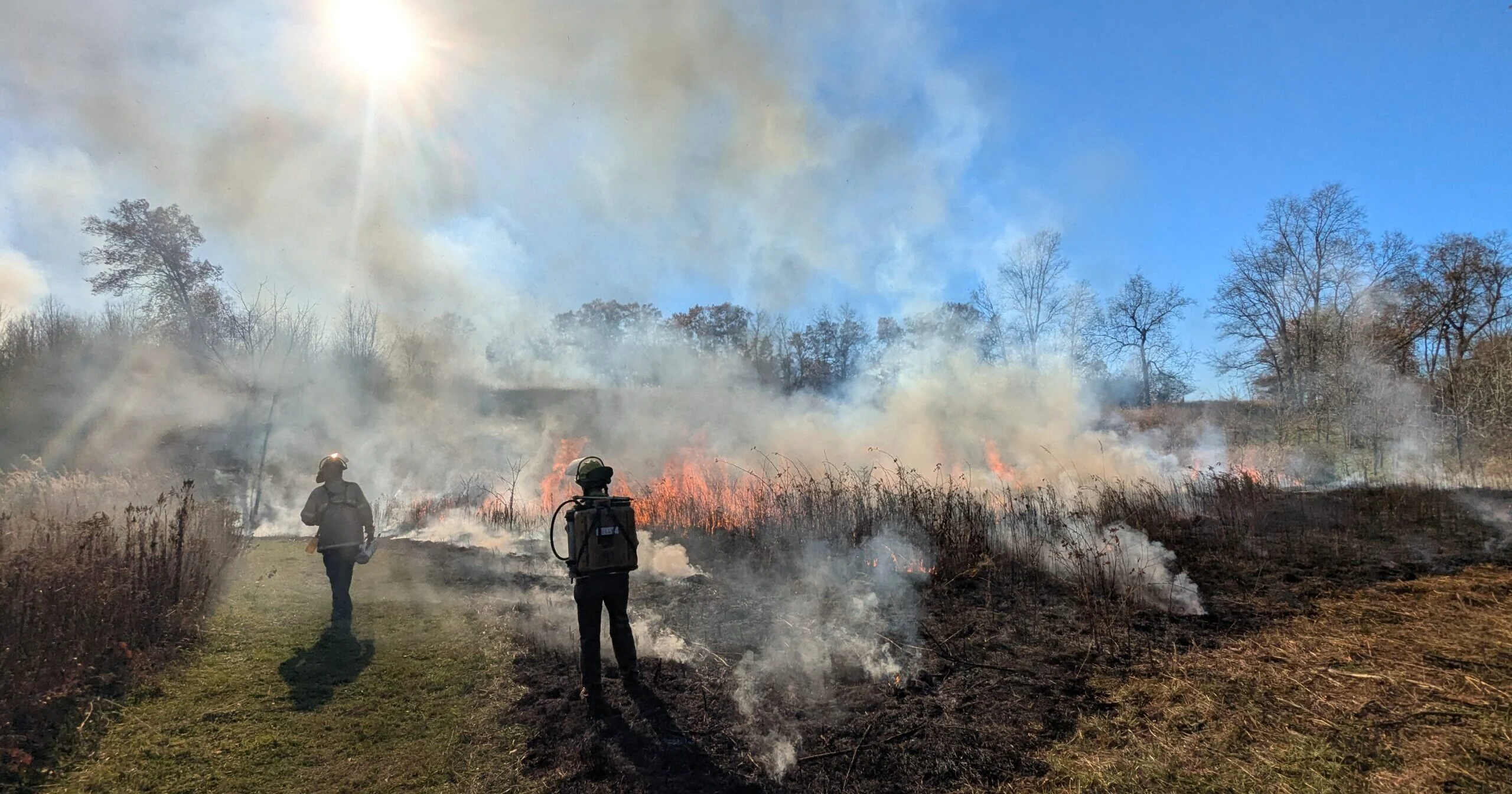
Spring and fall are two of the best and most typical times to perform a prescribed fire. Most of the fires we have on our sanctuaries occur in the spring. In some cases, this is because spring is an ideal time to burn dominated by cool-season grasses. In the fall, cool-season grasses, such as Smooth Brome (Bromus inermis), are lush green, making them difficult to burn. However, if a grassland is full of warm-season grasses, such as Big Bluestem, Switchgrass, Indian Grass, and Little Bluestem, then fall (or spring!) are great times to burn. At our Bernard Baker Sanctuary, we have typically burned in the fall to great success and so I continued with that this year with a planned burn of ~7.5 acres. There was some Smooth Brome in this unit, certainly, but I felt confident that in most cases, the fire would carry well. In reality, it did not. There was much more green underneath the warm-season grasses than I thought. However, areas with heavy Oak and Hickory leaf cover burned very well. Although the whole unit did not burn the way I would have liked, I’m happy to have gotten fire onto the ground in an area that hasn’t seen fire in many years.
In the future, I’ll be burning this unit in the spring and will likely need to change the schedule of a few burns in other units over the next few years. This concludes the burn season in 2026! We will pick back up in 2027 with three prescribed burns at Phyllis Haehnle Memorial Sanctuary, Otis Farm Bird Sanctuary, and Martha Mott Sanctuary, the latter of which probably hasn’t seen fire in decades.
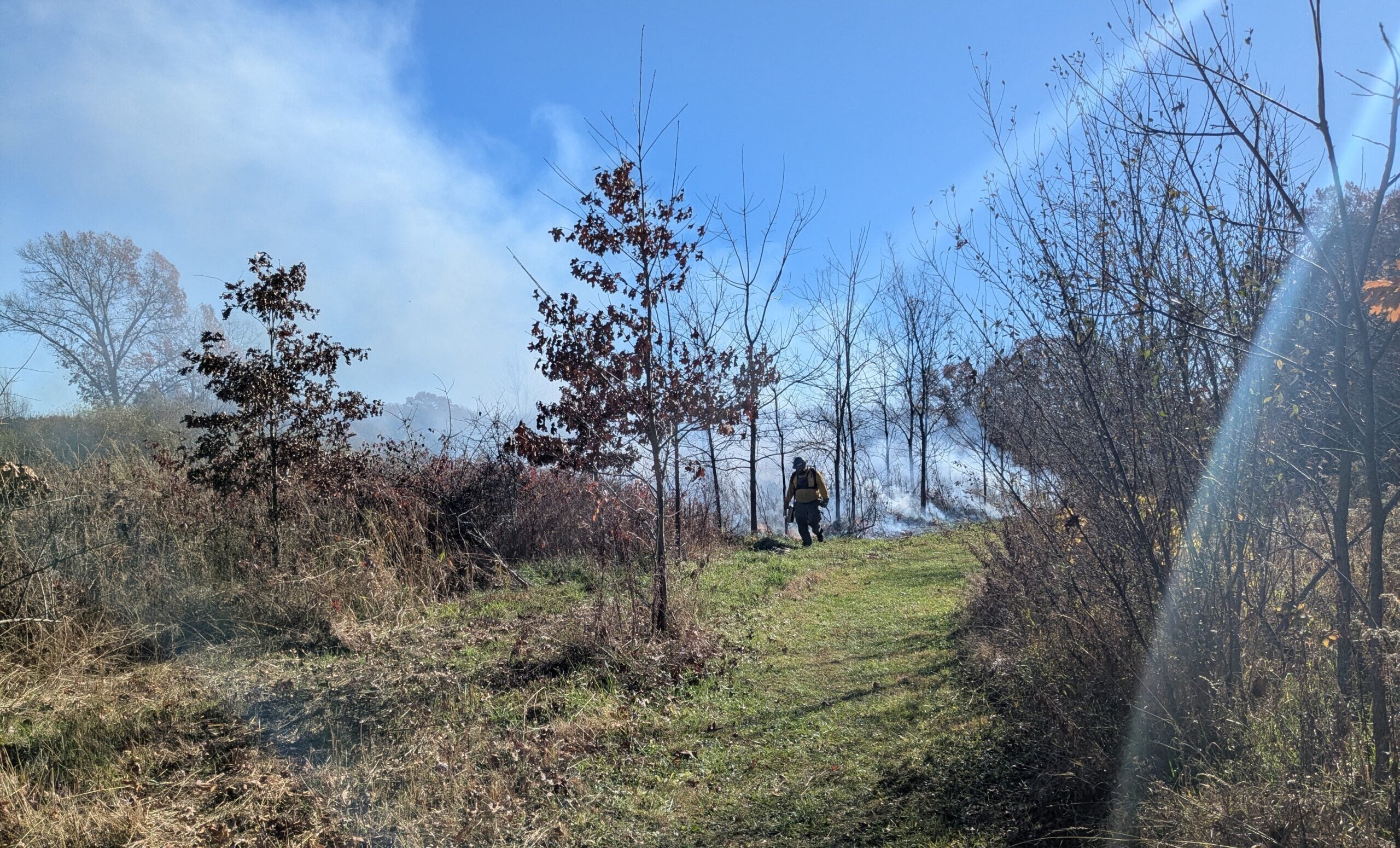
Member of the burn crew bringing fire down the line with a drip torch. Photo by Chad Machinski
A quick aside for birds…the morning of the burn day, I flushed three Woodcock from the trail while doing my morning trail check. I might have let out a gasp that you could hear across Big Lake Marsh when the first one shot up not 3 ft in front of me!
Capital City Bird Sanctuary
Fall is my favorite time to plant, whether it’s perennials, or whether it’s trees. Sure you have to wait several months to see the fruits of your labor, but you don’t have to go through the process of babying those plantings all summer long as the sun beats down on them. In fall I say, “stick em and forget em.” So that’s what we did at CCBS on November 12th. Myself and volunteers Katie, Eric, and Robert planted 122 native trees! 100 of these trees were bare root and consisted of Sugar Maple (Acer saccharum) and American Basswood (Tilia americana). The remaining 22 were a hodgepodge of trees that more or less fit the theme of Mesic Southern Forest: White Oak (Quercus alba), Black Cherry (Prunus serotina), Red Maple (Acer rubrum), and Sycamore (Platanus occidentalis). These 22 were donated trees, leftover from an MSU research project from my friend Jack, thanks Jack! I’ve been tending them all summer long in pots, eagerly awaiting their planting date.
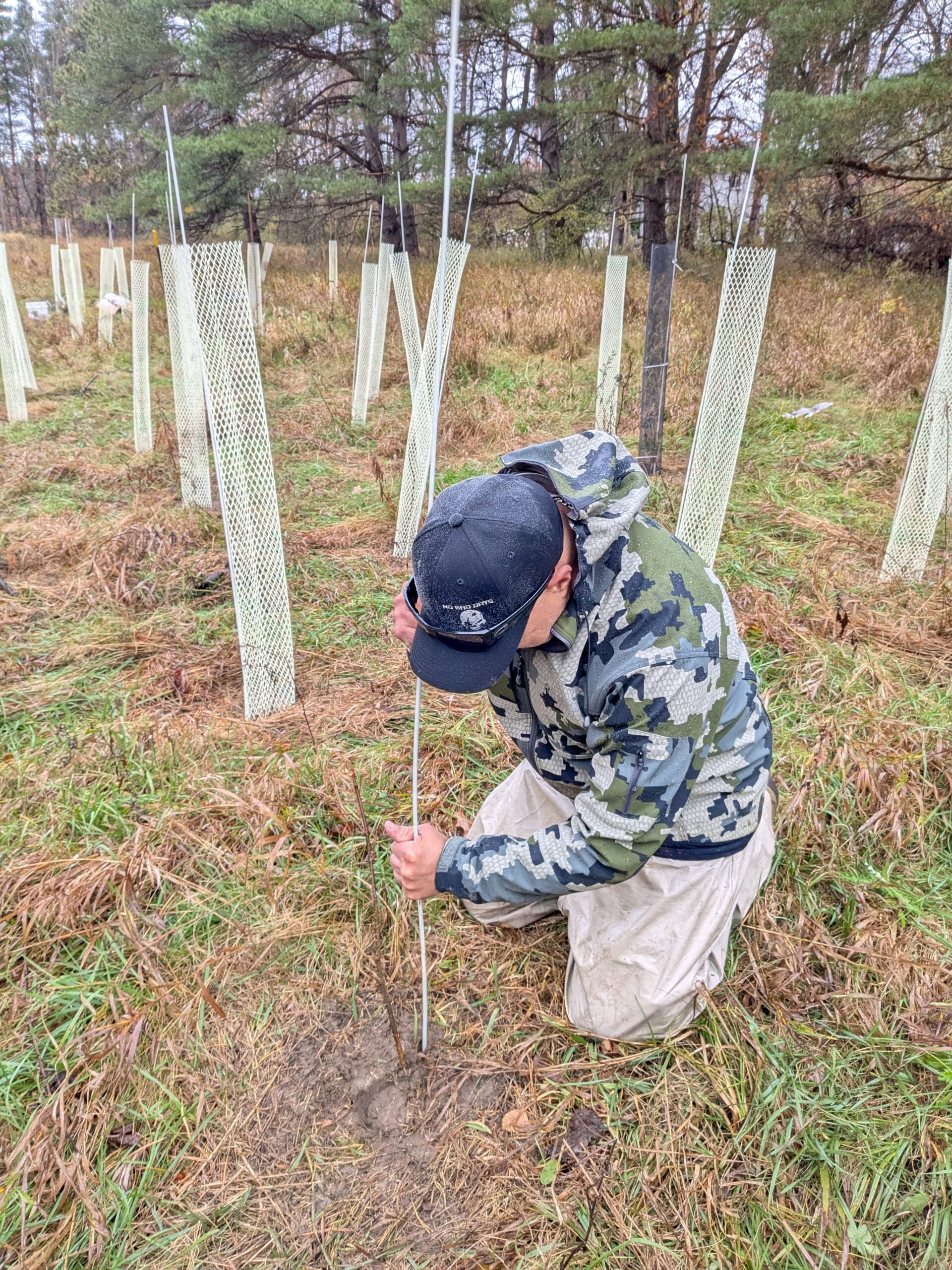
Volunteer Robert installing tree protection around an American Basswood. Photo by Chad Machinski
I’m not sure if anyone was outside in Lansing on November 12th, but the WILX Meteorologist described it as “raw and chilly”. This was a nice way of saying, “it sucked out there.” However, this really only described how us humans felt, if the trees we were planting could talk, they’d say “this is the most stellar day that I could imagine!” Planting and protecting all these trees took about 3.5 hours. In all likelihood, some of these trees won’t make it, that’s just the name of the game. But we won’t solely rely on planting trees to reforest this Sanctuary. What I’m finding is that despite the devastating amount of deer browse here, there are still some Red Oak (Quercus rubra), Sugar Maple, and Bitternut Hickory (Carya cordiformis) seedlings popping up. To supplement our tree planting, I am protecting these trees when I find them, giving them a chance to grow without being browsed on. Over the past two years that I’ve been doing this, I’ve been able to watch naturally occurring seedlings grow into saplings, some of which are just starting to grow taller than their protective tubes.
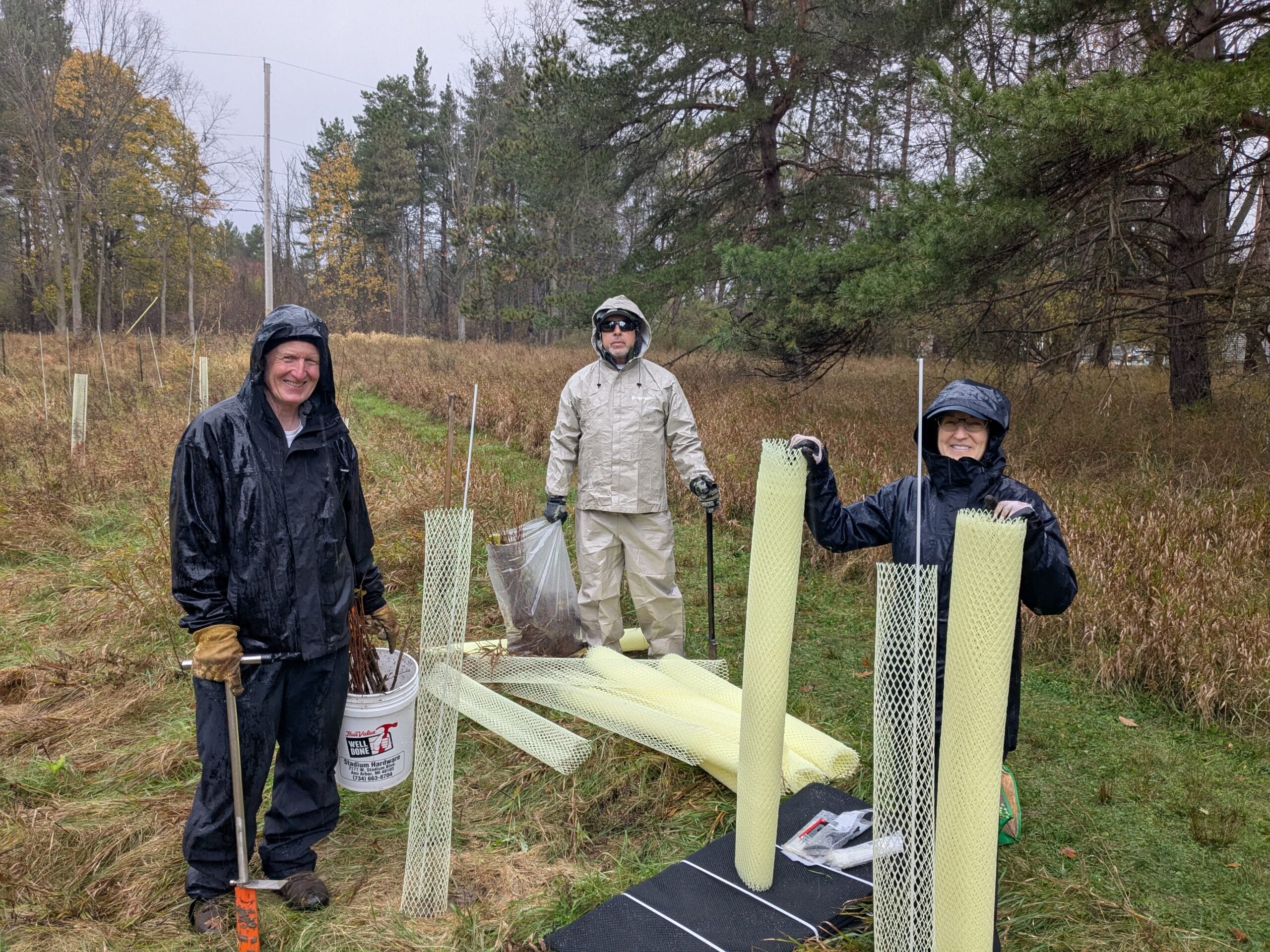
Volunteers Eric, Robert, and Katie suited up and ready to plant trees. Photo by Chad Machinski
Beyond planting and protecting trees in this space, we will continue with important work removing Scotch Pines (Pinus sylvestris) and addressing Reed Canary Grass (Pharlaris arundinaceae), Bittersweet (Celastrus orbiculatus), Wineberry (Rubus phoenicolasius), and Common Privet (Ligustrum vulgare).
To learn more about Michigan Audubon sanctuaries, visit michiganaudubon.org/conservation/bird-sanctuaries. If you want to volunteer at a Michigan Audubon sanctuary, please complete the Sanctuary Volunteer Interest Form.
Chad Machinski, MS
Conservation Manager
While Chad’s first love is botany, he doesn’t deny the intertwining nature of birds, plants, insects, and all other organisms we share the world with. His passion for the natural world began in his undergraduate time at the University of Michigan, taking several different forms along the way. His graduate studies at the University of Michigan allowed him to more closely examine the natural communities of Michigan and further understand the complex nature of ecosystems. His work as a Nichols Arboretum Caretaker while in school further enabled him to be directly involved in conservation work as he led workdays removing invasive plant species, performed trail maintenance, and guided tours. Chad can usually be found out in a park in a few ways: binoculars glued to his face, hunched over looking at plants, or flipping logs looking for snakes and salamanders.