


Conservation Manager Chad Machinski, M.S., manages the stewardship of MA’s sanctuaries and engages with our dedicated volunteers. To help you stay connected with the work being done, he will be presenting regular online updates about activities going on at them: birds seen or heard, conservation work, improvements, interesting plants, and more.
Alrighty, we are back with a Conservation Update! And if you opened this up thinking, “if this guy goes another month talking about *dry heaving* plants *dry heaving*, I’m boycotting Michigan Audubon!” you will be relieved to hear that this month’s blog will be about how our Sanctuary nest boxes did this year. Last time I wrote about our boxes was the June blog, so we have a few updated numbers for all.
Back to birds!
Purple Martins
If you recall from the June blog, our Purple Martin colonies were short a pair this year compared to 2025. At that time we had 11 eggs between the two colonies at Lake Lansing; out of those 11, 10 hatched, and out of those 10, nine survived to fledging. This is three fewer than 2025. Although one of the colonies fledged three fewer birds than 2025, the other colony fledged two more birds than in 2025. Twice in July we had extended extreme heat, with temperatures regularly in the mid- to upper 90s. We lost one nestling during that period, but I cannot say that it was certainly due to the heat. The heat definitely has some impact on the young birds in the nest. The colony that is made up of artificial gourds provides the nestlings, who are mouth agape attempting to expel excess heat, enough space to spread out and not be right on top of one another. Our other colony which is a metal “condo” is not as spacious and does not provide the space that the gourds do, which results in some nestlings still having to be touching one another.
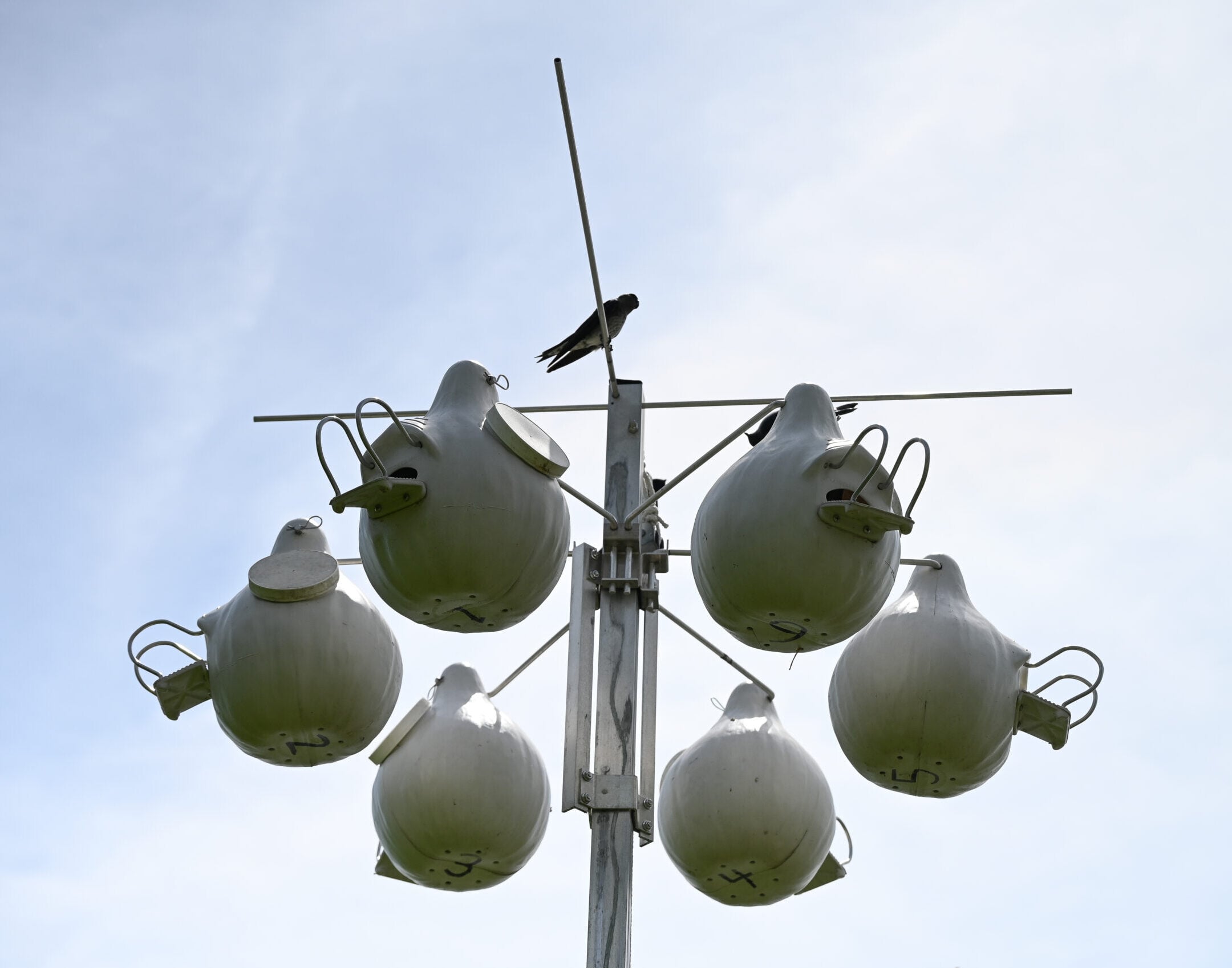
Artificial gourds at the Lake Lansing colony. Photo by Kristy Taylor
At this time, the housing remains up, but will be taken down and/or cleaned out for the winter in the next month. We hope that next year provides us with more Purple Martins. I would also like to extend a ‘Thank You’ to both Meridian Township and the Ingham County Parks Department who allow us to have the housing set up on their properties.
If you are a Purple Martin Landlord in the state of Michigan and actively manage and monitor your colony, please take a moment to submit an End-of-season Nest Report through our online reporting tool. We want to know how your colony did!
Otis Farm Bird Sanctuary
I would say that the results from the Otis Farm Bird Sanctuary nest boxes were the ones I was most anticipating. While I would check in on how things were going via NestWatch, I couldn’t fully appreciate it until the final numbers came in. Otis had two big stories in regards to nesting birds, the first being the 17 new and larger nest boxes that were installed this spring to replace older, smaller boxes. With the time and funds required to build new nest boxes (paid for by a TC Energy Grant), I was very hopefully that the new boxes would pay off in terms of Tree Swallows produced, and fortunately, it did. In total, we had 140 Tree Swallows fledge at Otis, this is 69% increase compared to the number of Tree Swallows fledged in 2025 and a 352% increase from 2024. These massive increases are due to a few things. In 2024 and years prior, these nest boxes lacked adequate predator guards and that year we had significant losses due to egg predation. Improvements were made to the predator guards for the 2025 season which more than doubled the Tree Swallows. However, I was not satisfied, so the next round of improvements came this spring in the form of the larger boxes, but also a change of box layout. Several nest boxes were paired which is a strategy that allows Tree Swallows and Bluebirds to nest near each one another. But at Otis, in most cases, only one box of the pair was ever used at once. While I’d love to say that it was purely the larger boxes that improved number of fledglings, it has really been a multi-year and multi-pronged approach.
Eastern Bluebirds had a pretty consistent year of nesting compared to years past, producing 25 fledglings compared to 21 in 2025, and 26 in 2024. The only reason there was a dip in 2025 was due to a bout of cold weather that killed an early nesting brood, otherwise it would have been right in line with 2024 and 2026.
House Wrens are increasing in line with the Tree Swallows, producing 87 fledglings in 2026 compared to 42 in 2025. It also seemed that there was fewer impacts on Tree Swallows by the House Wrens than last year. However, changes to layout do still need to occur, particularly with boxes that are near shrubby areas.
The second big story at Otis was the presence of the pair of Chimney Swifts that were nesting in the chimney of the farm house on site. The camera we installed was able to capture the development of the nest, egg laying, hatching, and nestling development. Unfortunately, things took a turn for the worst when a heavy rainstorm washed the nest off the wall of the chimney during the night. Two of the nestlings did not survive the night, while the other two were taken to the Bird Center of Michigan. One of the fledglings is on course to be released in a couple of weeks, but sadly, the other Swift succumbed to an apparent infection despite showing signs of improvement.
I’d like to thank nest box monitor Scott for his work walking up and down the hills of Otis monitoring boxes. Scott dedicated 92 hours to nest box monitoring!
Bernard W. Baker Sanctuary
I was pleased to look through the NestWatch data from Baker to see an increase in number of fledglings! Despite the fact that total nesting attempts did not increase between the four species we have nest boxes for, we fledged a total of 62 birds compared to 42 last year. Our Bluebirds were able to increase their nesting attempts and double their fledglings compared to 2025. This marks a return to near 2023 Bluebird fledgling numbers after we saw a 50% drop in 2024 and 2025.
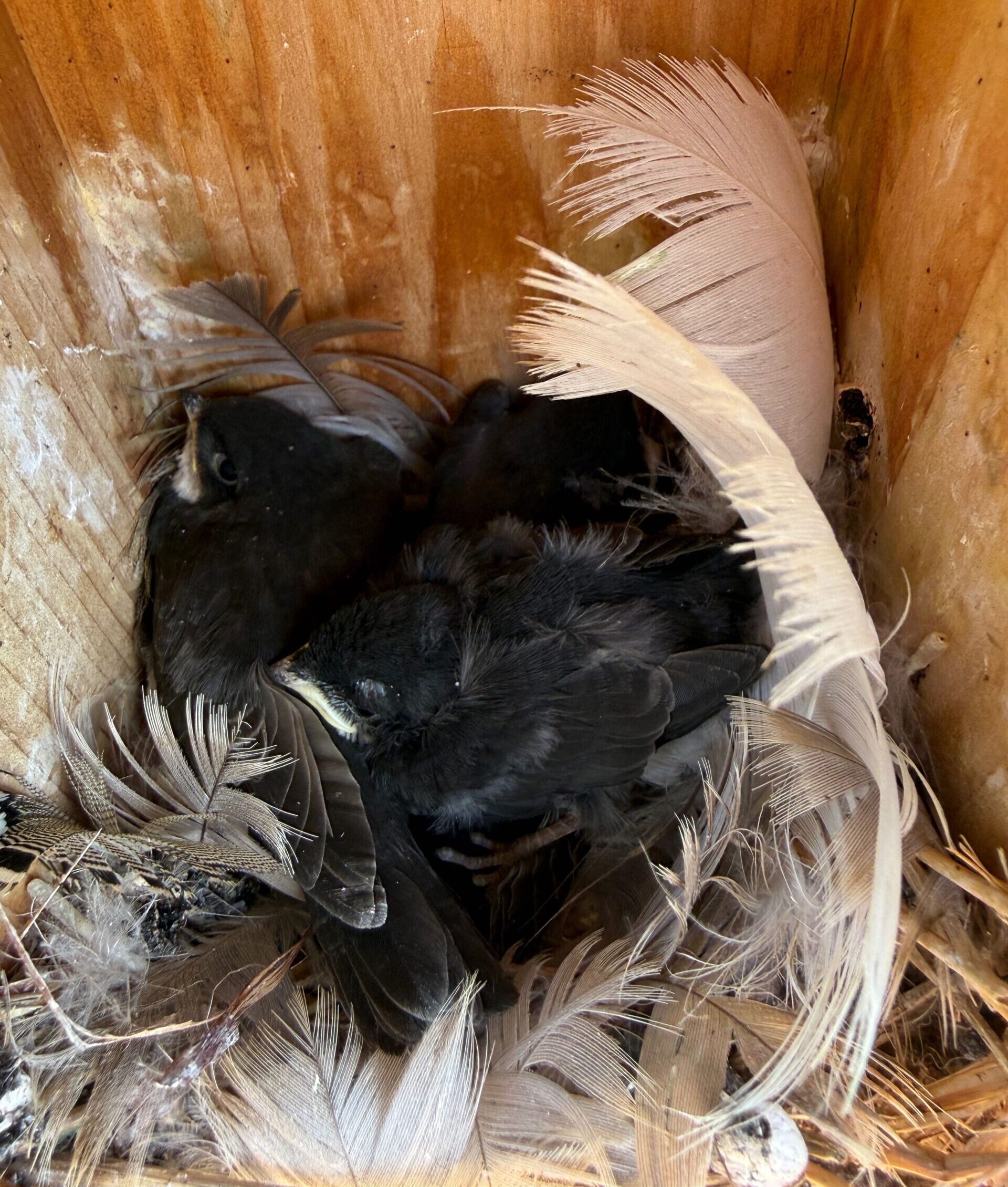
Tree Swallow nestlings at Bernard. Photo by Alex Johnson
Our Tree Swallows had one less nest attempt this year, but produced three more fledglings than 2025, indicating that nests were overall more successful. The 24 fledglings produced is on par with 2025 and 2023 numbers, but still lower than the 2024 record which was 32 fledglings. House Wrens produced the exact same number of fledglings compared to 2025: six. 2024 had been a banner year for House Wrens, producing 22 fledglings, but this really seems to have been an anomaly. Frankly, I am shocked that we do not have more House Wrens as many of our boxes are in areas that are being encroached by Autumn Olive. Black-capped Chickadees were able to also produce six fledglings, which is double the 2025 numbers, indicating an overall higher success rate.
I want to thank both Alex and Bobby for monitoring boxes this season. Bobby filled in for Alex while Alex was doing some bird banding work. Together they contributed 43.5 hours to nest box monitoring!
Capital City Bird Sanctuary
We had a strange phenomenon happen at Capital City Bird Sanctuary this season. Typically, the boxes in the meadow are full of Tree Swallows, and despite the nest box pairings, Bluebirds are pushed to slightly other boxes and produce fewer fledglings. This year, we had ZERO Tree Swallows attempt nests which of course resulted in zero fledglings. In 2025, Tree Swallows produced 26 fledglings. With the Tree Swallow vacancy, the Bluebirds made hay producing 41 fledglings, a significant increase from the EIGHT they produced last year. The departure of Tree Swallows is puzzling, especially since Tree Swallows were seen in the beginning of the season and nothing has changed in their immediate habitat that would result in site abandonment. Might this be part of their overall decline as aerial insectivores due to lack of insects? If it weren’t for significant increases at Otis, I might be fully behind this, and ultimately, it still may be partially responsible, but we will have to wait for subsequent years to see if this is just an aberration or not. Overall, we had 86 fledged birds between Bluebirds, House Wrens, Black-capped Chickadees, and Carolina Wren, which is an increase of 15 fledglings overall compared to 2025.
I want to thank Paul for his dedicated service as nest box monitor! He put in 60 hours of nest box monitoring this year!
Martha Mott Sanctuary
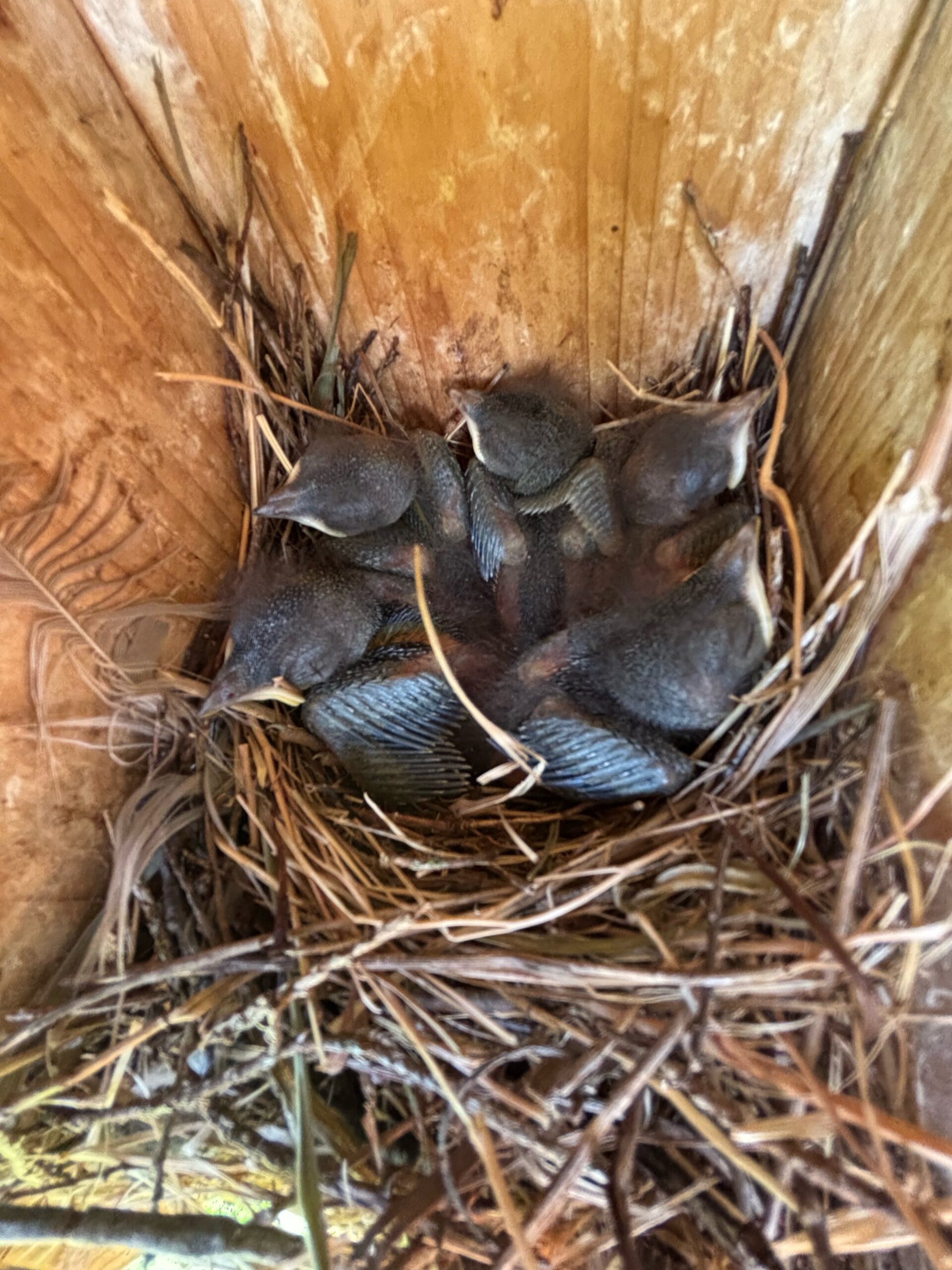
Eastern Bluebird nestlings at Martha Mott. Photo by Derek Haroldson
Martha Mott Sanctuary saw an increase in total fledglings from 54 (2025) to 74 (2026). Most of that increase came in the form of House Wrens, which accounted for 75% of that increase. But, we were able to see an increase in Tree Swallows by four and in Bluebirds as well, by one. Box MM-10 has now produced three Bluebird broods for three consecutive years! If I had to speculate, I would anticipate our House Wren numbers to increase over the next couple years, possibly at the expense of a few others. However, as we continue to restore this site to Oak Savanna, I’m hoping that the House Wrens will level off. Nest Box Monitor, Derek, had no issues with House Sparrows which has been a growing concern for me as there is a small neighborhood sharing a property line with the Sanctuary.
Our Wood Duck boxes remained unused all season, but it is very likely that there were Wood Ducks nesting in natural sites in the vicinity. We have not seen the same explosion of Red-headed Woodpeckers onsite like we did last year, however, they have been consistently reported on eBird throughout the season.
Thanks Derek for monitoring those nest boxes this season! Derek has dedicated 28.25 hours to all-things nest boxes this year.
Phyllis Haehnle Memorial Sanctuary
Last, but not least, we have the nest boxes of our Phyllis Haehnle Memorial Sanctuary. When looking at the data for Haehnle, I was amazed to see that 2025 and 2026 had the exact same number of Tree Swallows fledged: 57. The main difference between these two is that 2026 saw more nesting attempts by Tree Swallows meaning that they had a slightly lower success rate compared to 2025. Bluebirds saw an increase in fledged birds, 23 in 2025 vs. 36 in 2026, despite one less nesting attempt. House Wrens did decrease from 12 fledged birds to 4. Haehnle is also the only sanctuary to have a House Sparrow nesting attempt. This was not permitted to proceed. Haehnle was the only Sanctuary to have Wood Duck fledglings, with 8 presumed to have fledge.
Alex, who monitors Baker, also monitors at Haehnle. Thanks again Alex!
Now it is time to start making repairs and additions to the nest boxes where they are needed. If you hosted any birds in nest boxes in your own yard, I hope it was a successful year for you and thank you for your service!
Featured Photo: Purple Martins at the Lake Lansing colony. Photo by Chad Machinski
To learn more about Michigan Audubon sanctuaries, visit michiganaudubon.org/conservation/bird-sanctuaries. If you want to volunteer at a Michigan Audubon sanctuary, please complete the Sanctuary Volunteer Interest Form.

Chad Machinski, MS
Conservation Manager
While Chad’s first love is botany, he doesn’t deny the intertwining nature of birds, plants, insects, and all other organisms we share the world with. His passion for the natural world began in his undergraduate time at the University of Michigan, taking several different forms along the way. His graduate studies at the University of Michigan allowed him to more closely examine the natural communities of Michigan and further understand the complex nature of ecosystems. His work as a Nichols Arboretum Caretaker while in school further enabled him to be directly involved in conservation work as he led workdays removing invasive plant species, performed trail maintenance, and guided tours. Chad can usually be found out in a park in a few ways: binoculars glued to his face, hunched over looking at plants, or flipping logs looking for snakes and salamanders.