


Conservation Manager Chad Machinski, M.S., manages the stewardship of MA’s sanctuaries and engages with our dedicated volunteers. To help you stay connected with the work being done, he will be presenting regular online updates about activities going on at them: birds seen or heard, conservation work, improvements, interesting plants, and more.
OTIS FARM BIRD SANCTUARY
In 2025, myself and Otis Nest Box Monitor Scott replaced a handful of aging nest boxes with new nest boxes. The new boxes were the Gilbertson style boxes, which are cylindrical and made of PVC. I wanted to see if these were either preferred boxes or because they were paired with a typical box, if we would finally have both pairs of boxes being used, one by Bluebirds, and one by Tree Swallows. Out of the ten that were installed, all ten were used. All of the usual suspects used the boxes: Eastern Bluebirds, Tree Swallows, and Northern House Wrens. Out of the ten, seven of them produced successful nests. In a few instances both boxes of a pairing were used, however it was not the norm.
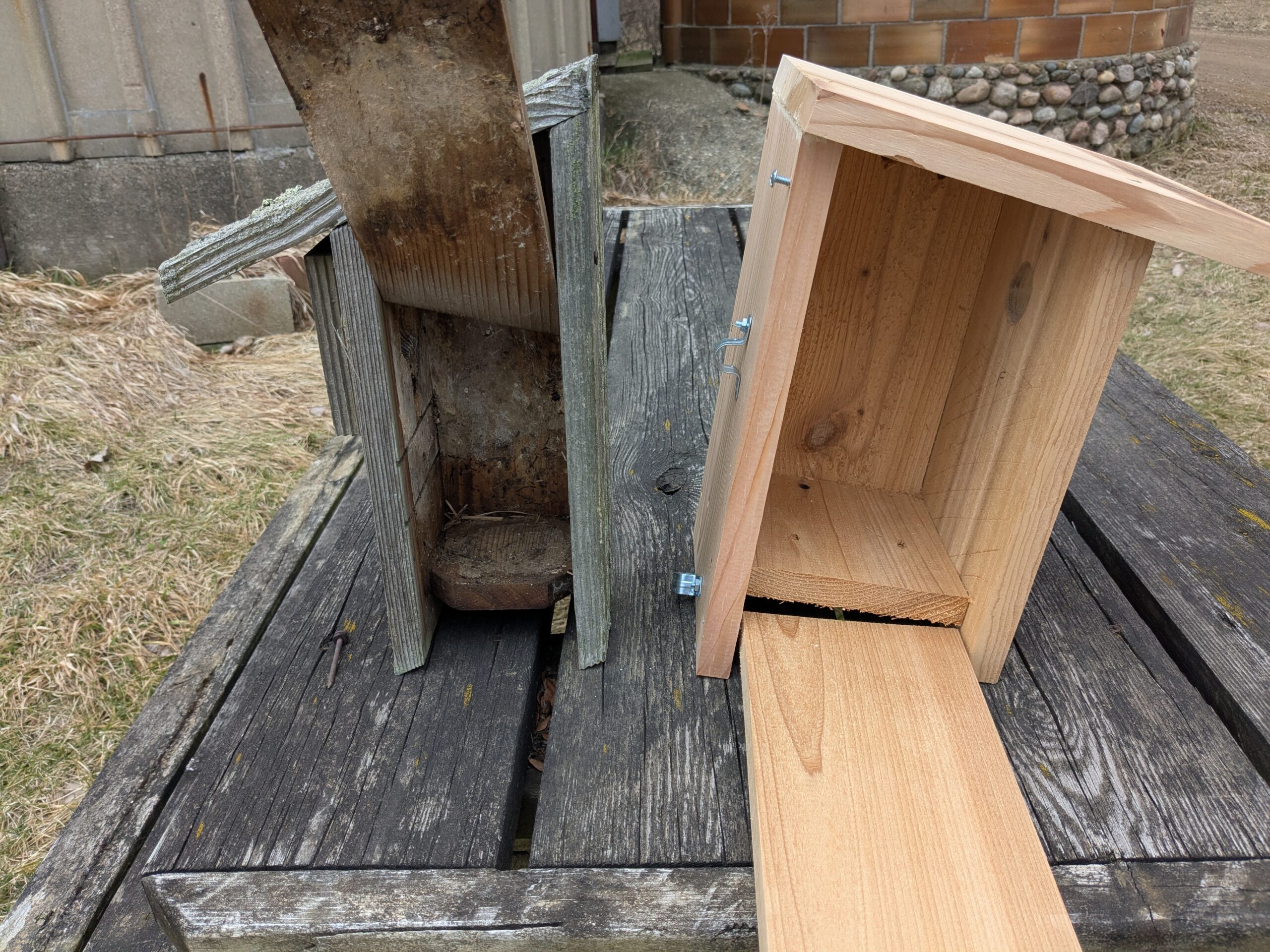
Photo of old nest box next to new nest box showing interior size difference. Photo by Chad Machinski
So at the end of last season when I was reviewing the data I decided that I would continue to tweak the nest boxes at Otis. I became interested in a larger sized nest box that was being promoted for Tree Swallows and decided to go that route. While any of the typical cavity nesters at Otis can use these boxes, I specifically wanted one that was best for Tree Swallows because that is the most abundant of the typical nesters (producing 83 fledglings in 2025). In addition, I decided that I would unpair many of the boxes since so many were going un-used, and I would alter the layout of boxes so that more Tree Swallows could nest. Using funds from a foundation grant, I built 18 nest boxes and purchased updated poles, baffles, and hardware.
On Tuesday, March 10th the work van sat in my driveway fully loaded with nest boxes, poles, and hardware. As I was getting ready to leave, assuring myself I had all the necessary supplies (I didn’t), my ear picked up a buzzing sound. After pausing and listening again, I realized that it was a Woodcock! In my neighborhood! In Lansing! It was still much too dark to see, but I determined that it was only a few houses away from mine. Starting the morning with a new “Yard Bird” was a great sign.
Out at Otis, while Scott did finishing touch ups on the boxes (sanding doors and entrance holes) I staged much of the equipment and supplies around the grassland so after lunch we could just focus on installation. While hauling supplies around the sanctuary, I was surprised to see TWO TREE SWALLOWS flying low over the grassland! Another great sign on the day.
After lunch, Scott and I began the endeavor of installing the nest boxes. I still had nest boxes, hardware, and three drills (to limit drill bit changes!) to haul in the equipment sled, and I was happy after each install when the sled got juuuuust a bit lighter. Using a rangefinder, each new box was placed no closer than 30 yards to the next box. In theory, this is the minimum distance to place these boxes apart and not have intensive territorial disputes between Tree Swallows. In addition, I wanted to move boxes further away from trails to reduce the potential for human interference with the boxes. In most instances, the new boxes were placed 25 yards away from the trail, however, some constraints forced a few boxes to be placed a bit closer to the trail.
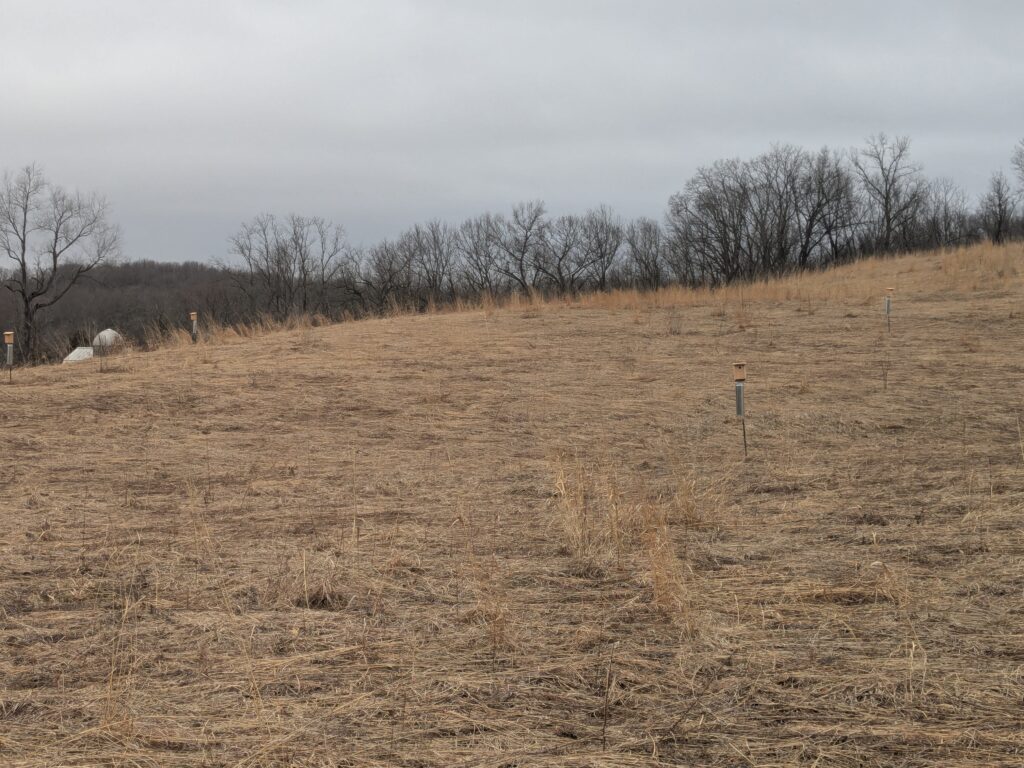
Photo of 4 new nest boxes installed in Unit 2.01. Photo by Chad Machinski
We installed boxes from 12:30pm to 5pm, removing 15 nest boxes, old poles, and baffles, and installed 17 new boxes, poles and baffles. We were supposed to install all 18, but we apparently left a box behind near the trailhead and decided that it could wait to be installed until I was back onsite in early April.
All nest boxes will be monitored throughout the breeding season, with data recorded into Cornell’s NestWatch. I’ve got high hopes for these boxes and the Tree Swallows (and Bluebirds) that they will support. Not matter the outcome, at the end of the season we will review the information.
To learn more about Michigan Audubon sanctuaries, visit michiganaudubon.org/conservation/bird-sanctuaries. If you want to volunteer at a Michigan Audubon sanctuary, please complete the Sanctuary Volunteer Interest Form.

Chad Machinski, MS
Conservation Manager
While Chad’s first love is botany, he doesn’t deny the intertwining nature of birds, plants, insects, and all other organisms we share the world with. His passion for the natural world began in his undergraduate time at the University of Michigan, taking several different forms along the way. His graduate studies at the University of Michigan allowed him to more closely examine the natural communities of Michigan and further understand the complex nature of ecosystems. His work as a Nichols Arboretum Caretaker while in school further enabled him to be directly involved in conservation work as he led workdays removing invasive plant species, performed trail maintenance, and guided tours. Chad can usually be found out in a park in a few ways: binoculars glued to his face, hunched over looking at plants, or flipping logs looking for snakes and salamanders.